How to increase in crochet (rows, rounds and evenly spaced)
Your pattern says "inc" and the stitch count in brackets keeps going up, but yours doesn't match. Here is how to increase in crochet, from the single stitch to a whole round: what an increase is, how to work one in single, half double and double crochet, how to read increases in a pattern, how to increase in the round and evenly across a row, and what to do when your circle starts to curl or ruffle.
What an increase is in crochet
An increase is two stitches worked into the same stitch of the row below. You use one stitch and make two, so every increase adds one stitch to the row.
Patterns write it in a few ways, and they all mean the same thing:
- inc
- sc inc
- 2 sc in next st
- 2 sc in same st
This post uses US terms. In UK patterns the same increase is written "2 dc in next st", because a US single crochet is a UK double crochet. There is a full side by side table in crochet terms and abbreviations: a US and UK chart.
How to increase in single crochet
- Work a single crochet into the next stitch, as usual.
- Put your hook back into the same stitch.
- Yarn over and pull up a loop. You have two loops on the hook.
- Yarn over and pull through both loops.
Two stitches now stand in one. The next instruction goes into the next stitch along, not into this one again.
How to increase in half double and double crochet
The idea is the same for every stitch: work the stitch, then work it again into the same place.
- Half double crochet increase: 2 hdc in next st (UK: 2 htr).
- Double crochet increase: 2 dc in next st (UK: 2 tr).
Tall stitches leave a small gap where the two stitches fan out from one. That is normal, and it is part of why double crochet circles look lacier than single crochet ones.
How to read increases in a crochet pattern
| The pattern says | What you do | Stitches added |
|---|---|---|
| inc, or 2 sc in next st | 2 sc in one stitch | 1 |
| 3 sc in next st | 3 sc in one stitch, common at corners | 2 |
| inc in each st around | an increase in every stitch, so the round doubles | 1 per stitch |
| (sc, inc) x 6 | sc in the next stitch, then inc in the one after, 6 times | 6 |
| *sc in next 2 sts, 2 sc in next st; rep from * around | the same thing written out, with 2 plain stitches between increases | 1 per repeat |
The number in brackets at the end of a row or round, like "(24 sts)", is the stitch total once that row is done. It is the easiest way to check your increases. More on reading patterns in how to read crochet patterns.
How to increase in the round
Almost every flat circle, hat crown and amigurumi piece grows by increasing in the round. In single crochet the rule is simple: start with 6 stitches and add 6 every round. Each round has one more plain stitch between the increases than the round before.
| Round | Instruction | Stitches |
|---|---|---|
| 1 | 6 sc in a magic ring | 6 |
| 2 | inc in each st around | 12 |
| 3 | (sc, inc) x 6 | 18 |
| 4 | (sc in next 2 sts, inc) x 6 | 24 |
| 5 | (sc in next 3 sts, inc) x 6 | 30 |
| 6 | (sc in next 4 sts, inc) x 6 | 36 |
| 7 | (sc in next 5 sts, inc) x 6 | 42 |
| 8 | (sc in next 6 sts, inc) x 6 | 48 |
Half double and double crochet are taller, so they need more stitches per round to stay flat. Half double crochet circles usually start with 8 or 10 stitches and add that many every round; double crochet circles usually start with 12 and add 12. Your pattern's numbers win if they differ. If you have not made the ring yet, start with how to make a magic ring. The charts for all three, rounds 1 to 10, are in how to crochet a circle.
Stagger the increases so the circle stays round
If every round puts its increases in the same six places, they stack into six corners and your circle turns into a hexagon. Move the increases around from one round to the next. For round 4 above, instead of (sc in next 2 sts, inc) x 6, you can work:
sc in next st, inc, *sc in next 2 sts, inc; rep from * 4 more times, sc in next st. (24 sts)
It uses the same 18 stitches and adds the same 6, but the increases sit halfway between last round's.
How to increase evenly across a row
Some patterns just say "increase 8 stitches evenly across". Work out the spacing yourself:
- Divide the stitches in the row by the number of increases. 40 stitches and 8 increases gives 5.
- Work the increase in the last stitch of each group: *sc in next 4 sts, inc; rep from * across.
- Check the new total: 40 + 8 = 48.
When it doesn't divide evenly, spread the leftover stitches out. For 42 stitches and 8 increases, 42 ÷ 8 is 5 with 2 left over, so make six groups of 5 and two groups of 6: (sc in next 4 sts, inc) 6 times, then (sc in next 5 sts, inc) 2 times. That uses 42 stitches and ends with 50.
To widen a piece at the edges instead, like a triangle shawl, increase in the first and last stitch of the row. That adds 2 stitches every row.
Common increase problems and how to fix them
- The circle curls up into a bowl: it has too few stitches for its size. Check you did every increase, or go up a hook size.
- The circle ruffles like a wave: it has too many. Check you didn't add an extra increase, or go down a hook size.
- Your total is off by one or two: count at the end of every round, before you start the next, and compare it with the number in brackets.
- You can't tell where the round starts: put a stitch marker in the first stitch of the round and move it up each round.
Frequently asked questions
What does inc mean in crochet?
Inc means increase: two stitches in the same stitch. In a single crochet pattern it means 2 sc in the next stitch. In other stitches the pattern usually says which, like "hdc inc" or "2 dc in next st".
Does an increase count as one stitch or two?
Two. You use one stitch from the row below and make two, so an increase adds one stitch to the total.
How do you increase in crochet without holes?
Single crochet increases leave almost no gap. In taller stitches a small gap is normal. To keep it tidy, stagger your increases so the gaps don't line up, and for amigurumi use single crochet with a hook a size smaller than the yarn label suggests.
What is the difference between an increase and a decrease?
An increase works two stitches into one stitch and adds a stitch. A decrease joins two stitches into one, like sc2tog, and takes a stitch away. Patterns use both to shape a piece, such as a ball that grows and then closes up. The steps for each kind of decrease are in how to decrease in crochet.
Where Rowpin helps
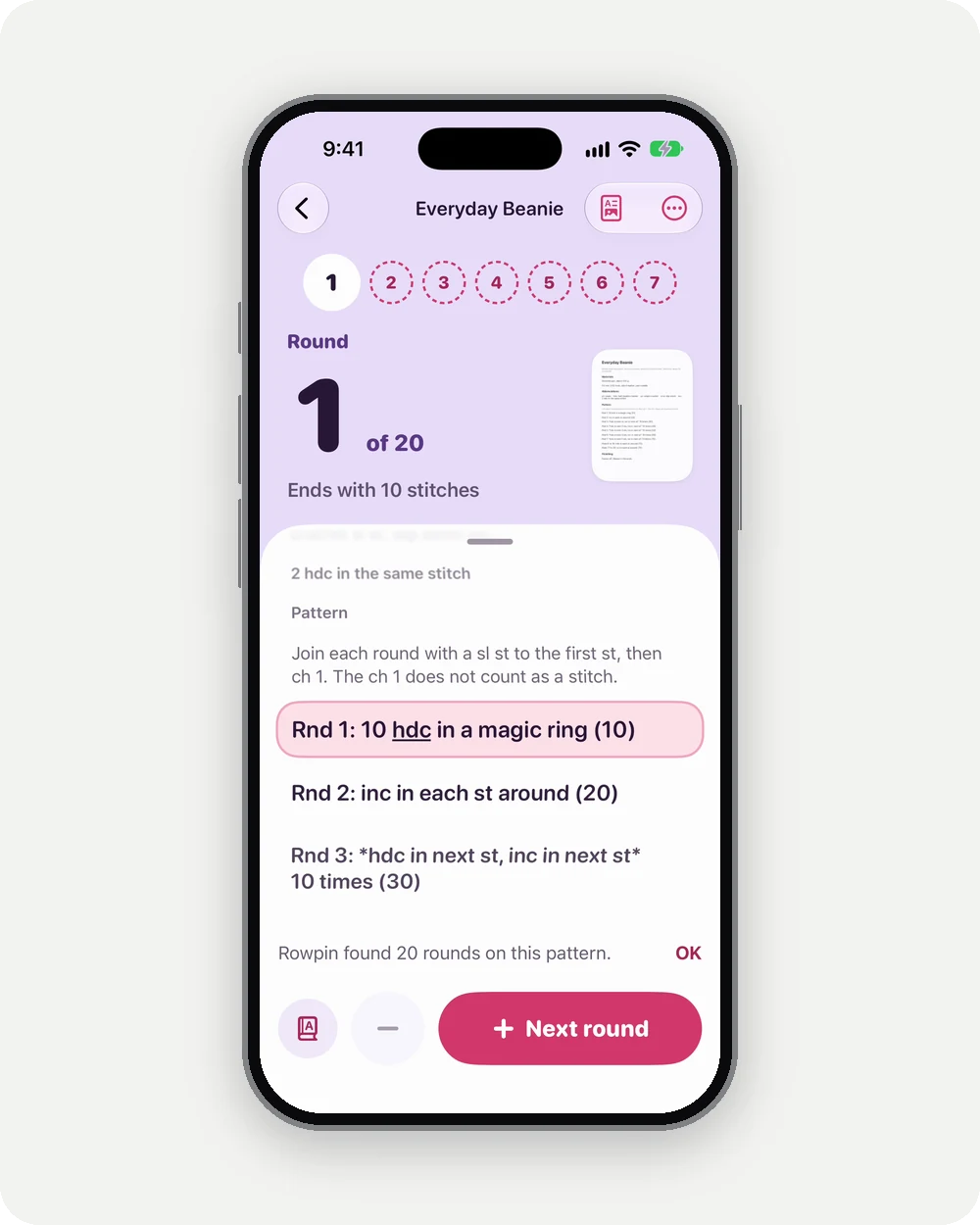
Increase rounds are where stitch counts drift. One missed "inc" in round 4 and every round after it is off, and you often only notice three rounds later when the shape looks wrong. Rowpin, the iPhone and iPad row counter app i built for crochet and knitting, keeps track of the round and its total for you.
You open your own pattern, a PDF, a photo, a scan or a web page, and Rowpin finds the numbered rows and rounds on it, right on your device, with no AI. As you tap + after each round, the round you are on is highlighted on your pattern, and when the pattern gives a stitch count like "(24 sts)", Rowpin shows it, so you can check your increases before you move on. You can count from the Lock Screen or a Home Screen widget without unlocking your phone.
Rowpin is on the App Store for iPhone and iPad. It needs Rowpin Plus, a subscription with a 7-day free trial.

Rowpin is not in the EU yet. Join the list to hear when it is. There is also a free row counter that works in your browser today.
Thank you for reading. Tschüss 🤓