How to read crochet patterns (and crochet charts)
The first time you see a crochet pattern, it looks a lot like code. "Rnd 3: *sc in next st, 2 sc in next st; rep from * around. (18 sts)". As a developer i honestly find that kind of beautiful, but it is a lot when all you want is to make a hat. So here is how to read a crochet pattern, one piece at a time, and at the end, how to read a crochet chart, the version drawn in symbols.
The parts of a crochet pattern
Most patterns are laid out in the same order. Before you pick up your hook, read the whole thing once from top to bottom.
- Skill level. Usually Beginner, Easy, Intermediate or Experienced.
- Materials. The yarn (its weight, and how much you need), the hook size, and extras like stitch markers and a yarn needle.
- Gauge. How many stitches and rows fit in a set size, usually 4 inches. It matters most for things that have to fit, like hats and sweaters.
- Finished size. If the pattern comes in sizes, they are written like "S (M, L)", and every number after that follows the same order. "Ch 40 (44, 48)" means 40 chains for small, 44 for medium and 48 for large. Highlight your size all the way through before you start.
- Abbreviations and special stitches. The pattern's key. Check whether it uses US or UK terms, because the same names mean different stitches.
- Notes. Things like "the turning chain counts as a stitch" or "work in continuous rounds". These are easy to skip and often explain the part that confuses you later.
- Instructions. Row by row, or round by round.
How to read a crochet pattern row
Here is a typical row, after a first row of 9 stitches:
Row 2: Ch 1, sc in first st, *2 sc in next st, sc in next st; rep from * across, turn. (13 sts)
Piece by piece:
- Row 2: you are working flat, and this is the second row.
- Ch 1: chain one. This is the turning chain, and in single crochet it does not count as a stitch.
- sc in first st: one single crochet in the first stitch.
- *2 sc in next st, sc in next st; is the part you repeat. Two single crochet in one stitch (an increase), then one in the next. It uses 2 stitches from the row below and makes 3.
- rep from * across: keep repeating that part to the end of the row. There are 8 stitches left, so you work it 4 times.
- turn: turn the work, ready for the next row.
- (13 sts): the stitch count. You should have 13 stitches when you finish. 1 plus 4 times 3 is 13.
That stitch count at the end of the row is your best friend. Count your stitches whenever the pattern gives one, and you will catch a mistake one row after you made it instead of ten.
Repeats: asterisks, brackets and parentheses
Repeats are where most people get lost, so it is worth knowing the common forms. Designers don't all use them the same way, so check the pattern's notes too.
- *...; rep from * 3 more times: work the part after the asterisk 4 times in total. The word "more" matters.
- [sc in next st, ch 1] 3 times: work what is inside the brackets 3 times.
- (sc, ch 2, sc) in next st: everything inside the parentheses goes into the same stitch.
- ** (two asterisks): a second repeat point, usually inside a longer repeat.
- across or around: to the end of the row, or to the end of the round.
Rows and rounds
"Row" means you work flat and turn at the end. "Rnd" means round: you work in a circle, usually without turning. Rounds either end with "join with sl st to first sc" or the pattern says to work in continuous rounds, a spiral with no join. I wrote a separate guide on the magic ring and working in the round.
US or UK terms?
If you see "sc" or "single crochet" anywhere, the pattern uses US terms, because UK patterns have no single crochet. Words like "htr", "miss" and "tension" mean UK terms. There is a full side by side table in crochet terms and abbreviations: a US and UK chart.
How to read a crochet chart or diagram
A crochet chart (also called a crochet diagram) is the same pattern drawn in symbols. The nice part is that the symbols are the same in US and UK patterns, so a chart doesn't care which terms you learned.
Each symbol is one stitch:
| Symbol | Stitch (US terms) |
|---|---|
| Small oval | Chain |
| Small filled dot | Slip stitch |
| + or x | Single crochet |
| T | Half double crochet |
| T with one line across the stem | Double crochet |
| T with two lines across the stem | Treble crochet |
The lines across the stem are a handy memory trick from double crochet up: they match the number of times you yarn over before you put the hook into the stitch. One for double crochet, two for treble.
To read the chart itself:
- Charts for rows are read from the bottom up. The row number sits at the end where that row starts. If you crochet right-handed, row 1 usually reads from right to left, row 2 from left to right, and so on, back and forth.
- Charts for rounds start in the center. If you crochet right-handed, you read each round counterclockwise.
- If you crochet left-handed, flip both: rows start on the left and rounds go clockwise.
- Many charts draw alternate rows in different colors so you can tell them apart. Check the key to see whether a color means a change of yarn.
A few habits that help
- Read the whole pattern once before you start.
- Make the gauge swatch for anything that has to fit.
- Mark your size, if there are sizes.
- Count your stitches at every stitch count.
- Keep your place with a highlighter, or a sticky note under the row you are on.
Frequently asked questions
What does "rep from * 2 more times" mean?
Work the part after the asterisk 3 times in total: once, then 2 more times.
What does the number in brackets at the end of a row mean?
It is the stitch count, how many stitches you should have at the end of that row or round.
Do I need to learn to read crochet charts?
No. Many patterns give written instructions and a chart, and you can use either. Charts are worth learning for lace and motifs like granny squares, where the picture shows the shape faster than the words.
Where Rowpin helps
Keeping your place is half of reading a pattern, and that is the part Rowpin does. It is the iPhone and iPad app i built for crochet and knitting.
You open your own written pattern, a PDF, a photo, a scan or a web page, and Rowpin finds the numbered rows on it, like "Row 12", "Rows 8-15" or "Rnd 14", right on your device, with no AI. As you tap + after each row, the row you are on is highlighted on your pattern, so you never have to find your line again. When the pattern gives a stitch count for the row, Rowpin shows it. And if an abbreviation stops you, Explain shows the row's abbreviations, from your pattern's own key first, in US or UK terms.
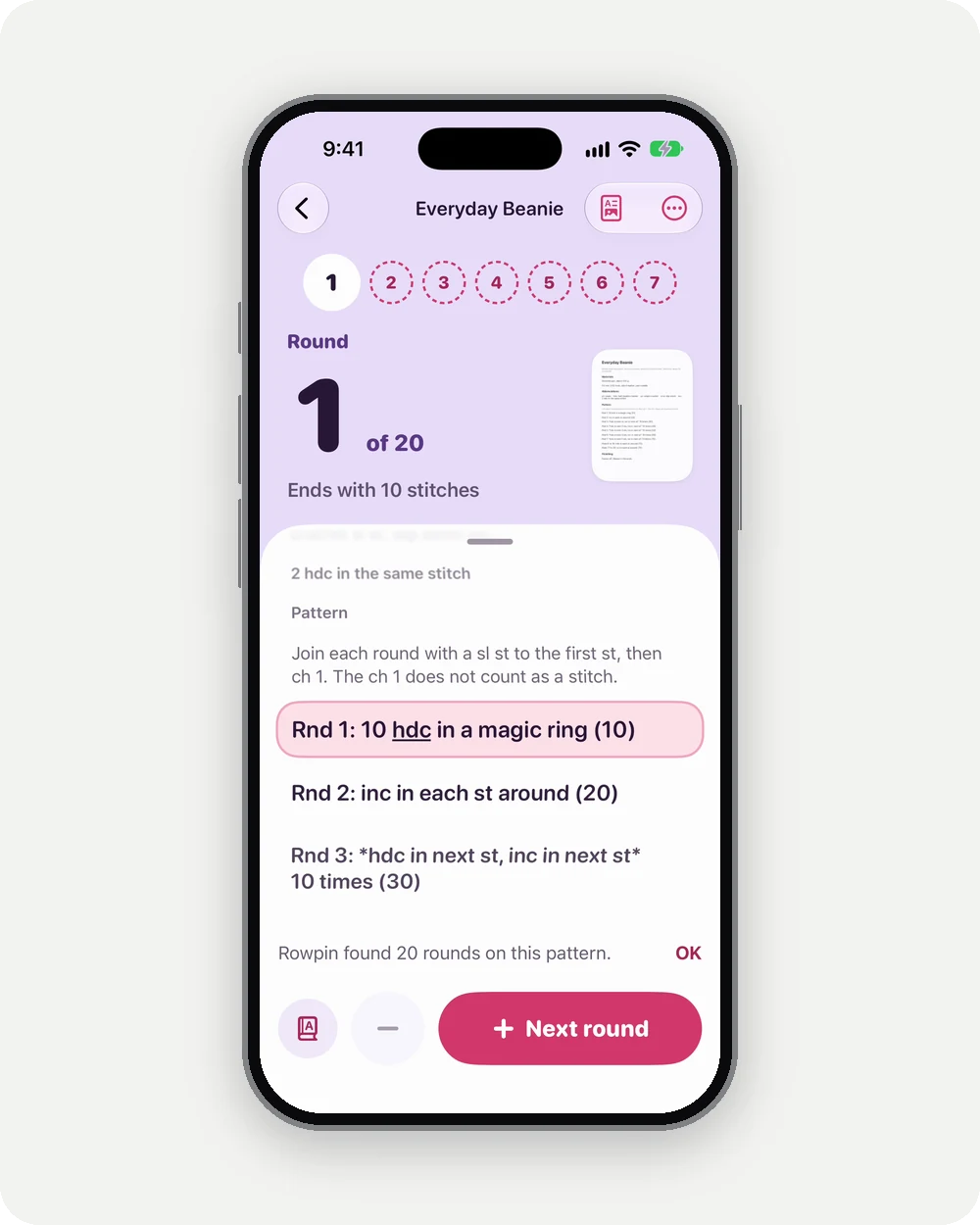
It reads written patterns, so a pattern that is only a symbol chart won't have rows for it to find.
Rowpin is on the App Store for iPhone and iPad. It needs Rowpin Plus, a subscription with a 7-day free trial.

Rowpin is not in the EU yet. Join the list to hear when it is. There is also a free row counter that works in your browser today.
Thank you for reading. Tschüss 🤓