How to decrease in crochet (sc2tog, invisible decrease, hdc2tog and dc2tog)
Your amigurumi head has to close up, or the pattern says "sc2tog" and you are not sure which loops go where. Here is how to decrease in crochet: the single crochet decrease (sc2tog), the invisible decrease, hdc2tog and dc2tog step by step, how decreases are written in a pattern, and how to decrease in the round and evenly across a row.
How to decrease in crochet: what a decrease is
A decrease joins two stitches from the row below into one stitch at the top. You use two stitches and make one, so every decrease takes one stitch away. It is the opposite of an increase, which works two stitches into one. If you have not met those yet, see how to increase in crochet.
Every decrease works the same way: start a stitch, start another in the next stitch, and finish them together.
This post uses US terms. In UK terms a single crochet is a double crochet (dc), a half double is a half treble (htr) and a double crochet is a treble (tr). So a UK "dc2tog" is the US sc2tog, and a US dc2tog is a UK "tr2tog". The full table is in crochet terms and abbreviations: a US and UK chart.
How to do a single crochet decrease (sc2tog)
- Put your hook into the next stitch, yarn over and pull up a loop. You have 2 loops on the hook.
- Put your hook into the stitch after that, yarn over and pull up a loop. You have 3 loops on the hook.
- Yarn over and pull through all 3 loops.
One stitch top now sits over two stitches below.
How to do an invisible decrease
The invisible decrease is a single crochet decrease worked through the front loops only. It leaves a smaller bump than sc2tog, so it is the usual choice for amigurumi, where you work in rounds with the right side facing you.
- Put your hook into the front loop only of the next stitch. Don't yarn over.
- Put your hook straight into the front loop only of the stitch after that. You have 3 loops on the hook.
- Yarn over and pull through the 2 front loops. You have 2 loops on the hook.
- Yarn over and pull through both loops.
The front loop is the one closest to you. If a pattern says "dec" without saying which, either decrease gives the same stitch count.
How to decrease in half double crochet (hdc2tog)
- Yarn over, put your hook into the next stitch, yarn over and pull up a loop. You have 3 loops on the hook.
- Yarn over, put your hook into the stitch after that, yarn over and pull up a loop. You have 5 loops on the hook.
- Yarn over and pull through all 5 loops.
Five loops is a lot to pull through at once. If it sticks, pull each loop up a little looser and keep them the same height.
How to decrease in double crochet (dc2tog)
- Yarn over, put your hook into the next stitch, yarn over and pull up a loop. You have 3 loops on the hook.
- Yarn over and pull through 2 loops. You have 2 loops on the hook.
- Yarn over, put your hook into the stitch after that, yarn over and pull up a loop. You have 4 loops on the hook.
- Yarn over and pull through 2 loops. You have 3 loops on the hook.
- Yarn over and pull through all 3 loops.
Each half is a double crochet stopped one step early, and the last pull joins them at the top.
Decreasing two stitches at once: sc3tog
Pull up a loop in each of the next 3 stitches, so you have 4 loops on the hook, then yarn over and pull through all 4. You use three stitches and make one, so it takes two away. You see it at the point of a triangle or a V.
How decreases are written in crochet patterns
| The pattern says | What it means | Uses | Makes | Stitches removed |
|---|---|---|---|---|
| dec | a decrease; in amigurumi usually sc2tog or an invisible decrease, the notes say which | 2 | 1 | 1 |
| sc2tog | single crochet 2 together | 2 | 1 | 1 |
| invdec, inv dec | invisible decrease | 2 | 1 | 1 |
| sc3tog | single crochet 3 together | 3 | 1 | 2 |
| hdc2tog | half double crochet 2 together | 2 | 1 | 1 |
| dc2tog | double crochet 2 together | 2 | 1 | 1 |
Like increases, decreases often sit inside a repeat. "(sc in next 2 sts, dec) x 6" means two plain single crochet, then a decrease, six times. Each repeat uses 4 stitches and makes 3, so the round uses 24 and ends with 18. The number in brackets at the end, like "(18 sts)", is the total you should have. More on repeats in how to read crochet patterns.
How to decrease in the round
Closing a ball or the top of an amigurumi head is a flat circle in reverse: you take away 6 stitches every round, with one fewer plain stitch between the decreases each time.
| Round | Instruction | Uses | Stitches |
|---|---|---|---|
| start | the last full round | 30 | |
| 1 | (sc in next 3 sts, dec) x 6 | 30 | 24 |
| 2 | (sc in next 2 sts, dec) x 6 | 24 | 18 |
| 3 | (sc in next st, dec) x 6 | 18 | 12 |
| 4 | dec x 6 | 12 | 6 |
Stuff the piece before the hole gets too small for your fingers, usually around 18 or 12 stitches. When you reach 6, cut the yarn with a long tail, thread it on a yarn needle, pass it through the front loop of each of the 6 stitches, and pull it tight like a drawstring.
If the decreases stack into visible lines, move them around from round to round, the same way you stagger increases.
How to decrease evenly across a row
When a pattern says "decrease 8 stitches evenly across", work out the spacing yourself:
- Divide the stitches in the row by the number of decreases. 40 stitches and 8 decreases gives 5.
- Make the decrease the last 2 stitches of each group: *sc in next 3 sts, sc2tog; rep from * across.
- Check the total: each group uses 5 and makes 4, so 40 stitches become 32, which is 40 minus 8.
When it doesn't divide evenly, spread the leftovers out. For 45 stitches and 6 decreases, 45 divided by 6 is 7 with 3 left over, so make three groups of 8 and three groups of 7, and alternate them: (sc in next 6 sts, sc2tog), then (sc in next 5 sts, sc2tog), three times. That uses 8 + 7 three times, which is 45, and ends with 39.
To narrow a piece at the edges instead, work sc2tog over the first 2 stitches and the last 2 stitches of the row. That takes 2 stitches away every row.
Common decrease problems
- A hole where the decrease is: you may have skipped a stitch instead of joining two. Skipping also takes a stitch away, but it leaves a gap.
- The count is off at the end of a round: count after every decrease round, before you start the next one. One missed decrease shows up as one extra stitch.
Frequently asked questions
What does dec mean in crochet?
Dec means decrease: two stitches worked together into one. In single crochet patterns it usually means sc2tog or an invisible decrease. The pattern's notes say which, and both give the same stitch count.
What is the difference between sc2tog and an invisible decrease?
Both turn two stitches into one. Sc2tog goes through both loops of each stitch. The invisible decrease goes through the front loops only, which hides it better on the right side of amigurumi.
How do you decrease in crochet without leaving holes?
Join two stitches with sc2tog or an invisible decrease rather than skipping one. In amigurumi, use the invisible decrease and a hook a size smaller than the yarn label suggests, so the fabric stays tight.
Where Rowpin helps
Decrease rounds go fast and look alike. (sc in next 3 sts, dec), then (sc in next 2 sts, dec), and suddenly you can't remember which one you just did. The total drops by 6 every round, so the stitch count at the end of each round is the quickest way to tell where you are.
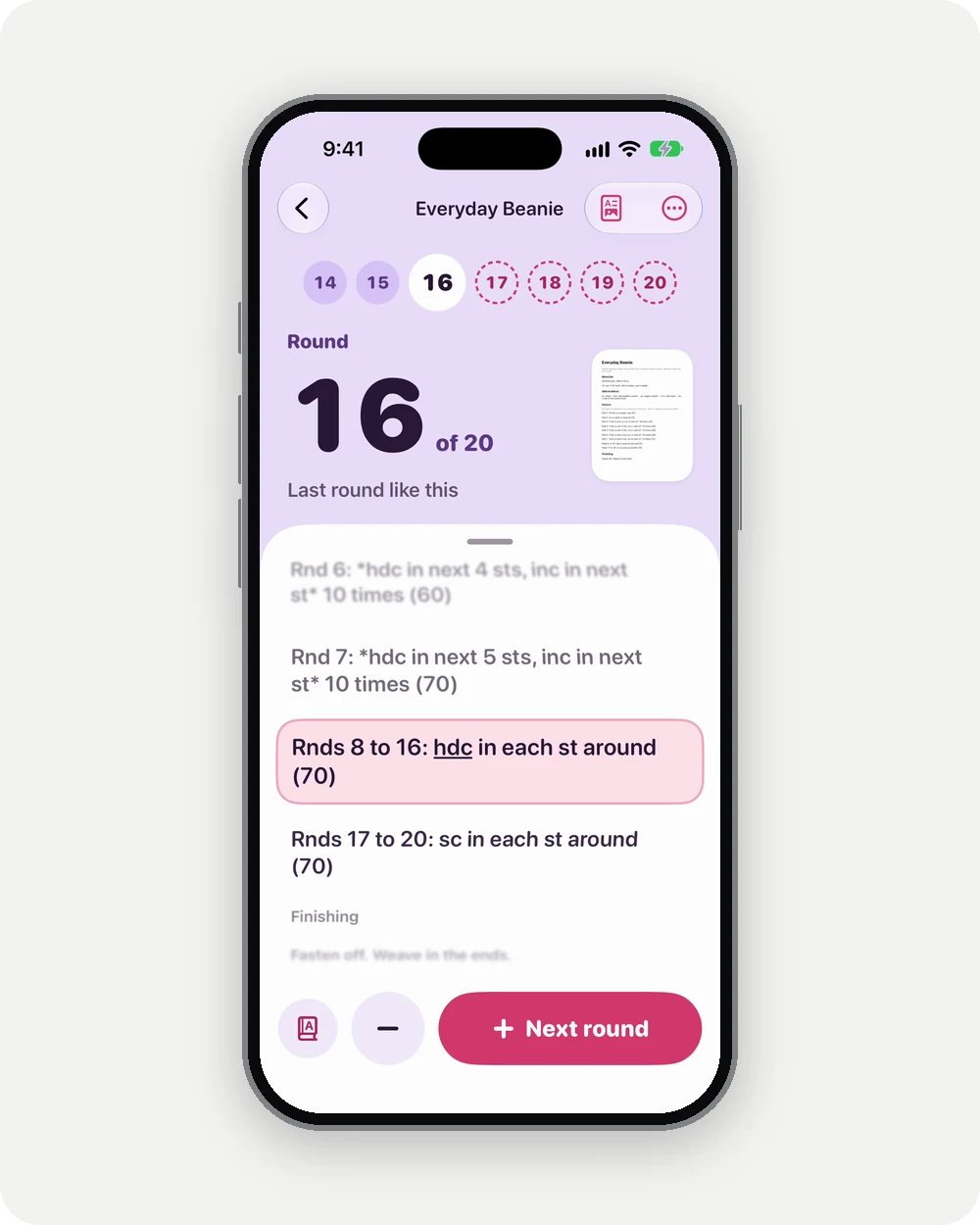
Rowpin, the iPhone and iPad row counter app i built for crochet and knitting, keeps that in front of you. You open your own pattern, a PDF, a photo, a scan or a web page, and Rowpin finds the numbered rows and rounds on it, right on your device, with no AI. As you tap + the round you are on is highlighted on your pattern, and when the pattern gives a stitch count for the round, Rowpin shows it. Abbreviations like hdc are underlined on the round you are working, and you can tap one to see what it means. You can count from the Lock Screen or a Home Screen widget without unlocking your phone.
Rowpin is on the App Store for iPhone and iPad. It needs Rowpin Plus, a subscription with a 7-day free trial.

Rowpin is not in the EU yet. Join the list to hear when it is. There is also a free row counter that works in your browser today.
Thank you for reading. Tschüss 🤓