From one question at an AI event to working at a European startup
A while back I went to an AI event here in Uganda, at the Innovation Village. Yves, the founder of PaperCheck, was presenting on prompting techniques and the tools around them, and somewhere in the middle of it I had a question I just couldn't keep to myself.
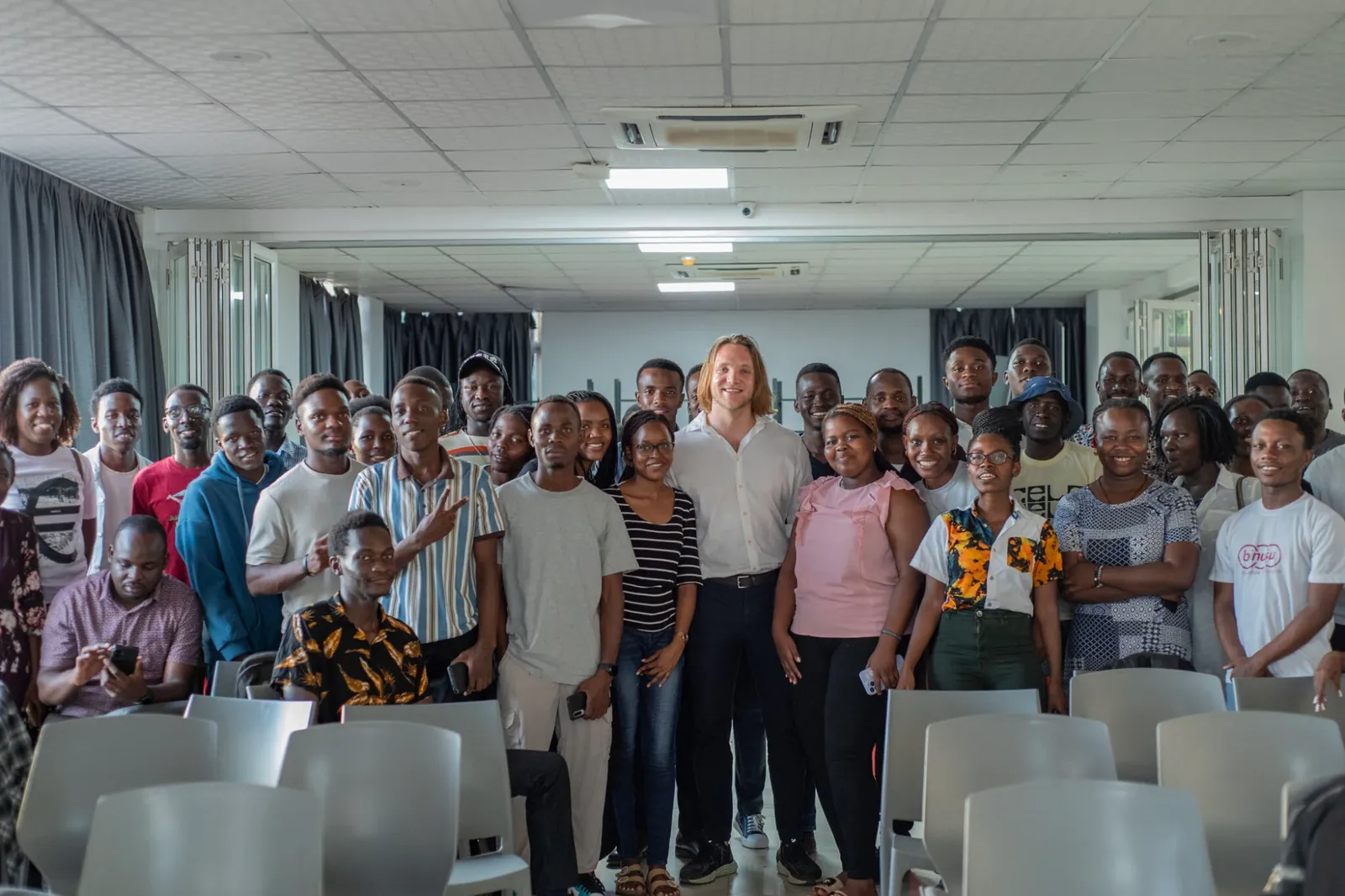
I wanted to know about fine-tuning. Could you take a smaller model and fine-tune it to do well on one specific task, for the cases where a big model is too hard to run or just too expensive? It's something I care about a lot, I've even written about routing between cheaper and more expensive models with RouteLLM.
He answered it, and after the event I sent him a connection request on LinkedIn with a short note to say thank you. I still had more questions, so I followed up, and he answered those too. And for a while, that was that.
Then in October 2024 I started looking for a job, and I remembered that conversation. So I messaged Yves and asked if there was a chance we could work together.
He asked about my stack, and then whether I had worked with LangGraph. As it turned out, I had, quite a lot actually, since I'd recently started building AI agents and documenting them on my YouTube channel. I still told him I'd take a short refresher course before we started, just to be sure, so I went through AI Agents in LangGraph on DeepLearning.AI, Andrew Ng's learning platform, taught by Harrison Chase who co-founded LangChain. I wanted to learn it properly from the people who built it. We set up a call for the next Monday, he gave me a few tasks to see how I work, and that's how it all started.
Those first months were freelance work. One of the projects was MoneyHaxx, a WhatsApp bot to help people negotiate their salaries, which I built with LangChain and Python on the WhatsApp API, and which also meant learning my way around Meta Business Manager. Alongside that I was slowly getting to know PaperCheck itself, picking up small tasks in the codebase and helping with things that weren't code at all. By June 2025 we had turned it into a contract.
So what is PaperCheck? It helps students write a better thesis. You upload your work and it reviews it with AI, pointing out the gaps, whether that's the structure, the argument or the small things like grammar and punctuation, and how you could improve them.
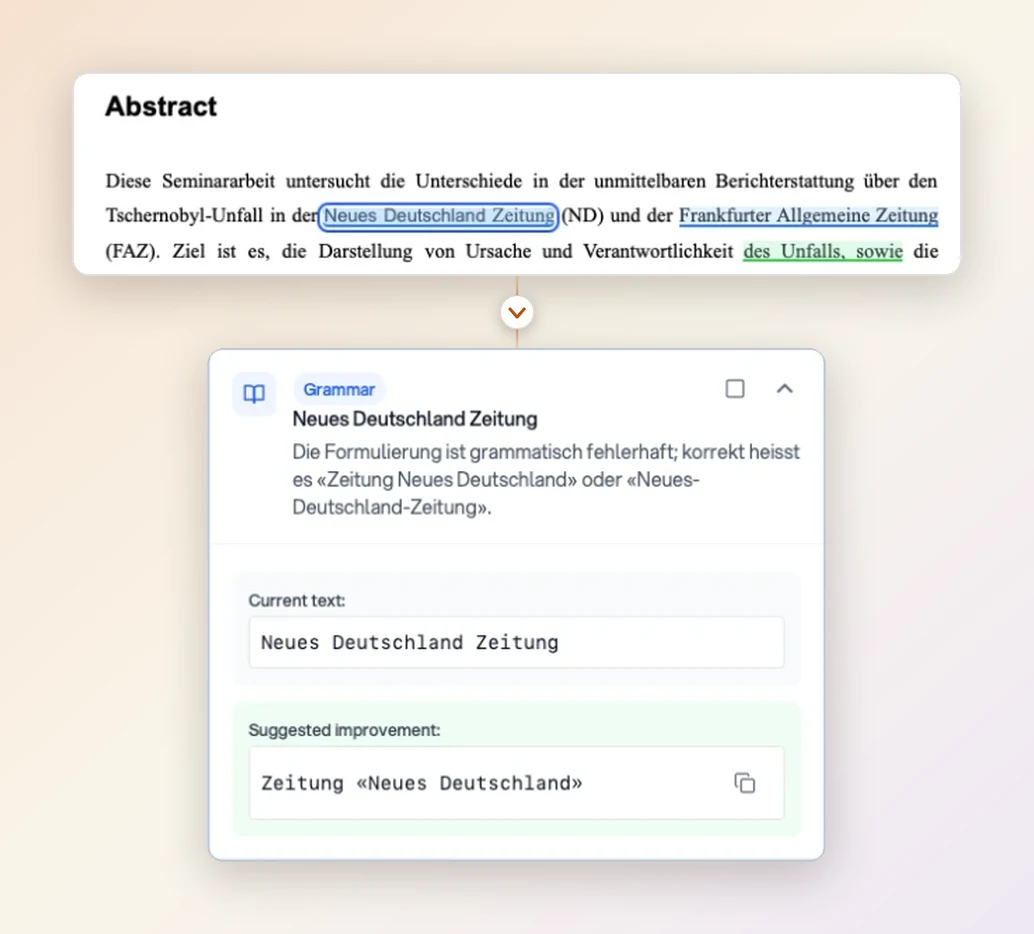
One of the first full features I designed, built and tested myself was page feedback. Instead of one long report, you see your thesis page by page with the issues underlined right in the text, and next to it a card for each one: what's wrong, your current text, a suggested improvement you can copy, and a checkbox to mark it done once you've fixed it. It works for German theses too. I like it because it's closer to how a good supervisor works. They don't hand you a list, they write in the margin right next to your sentence.
But none of that matters if the site is down when you need it. Imagine checking your thesis the night before a deadline and the page won't load! So the thing I'm most proud of is the part nobody really sees, keeping the site stable. A lot of my time went into the unglamorous parts: tuning how we talk to PostgreSQL, getting connection pooling right for a serverless setup, handling concurrency, and adding timeouts and retries so one slow service doesn't take everything else down with it.
The hardest stretch came right when my contract started. In June 2025 we moved from paying per upload to a credits system, and at the same time encrypted the sensitive fields we store about users. Neither of them was a fresh start. There were real users with real data that we couldn't break, so the planning had to be right to the dot, and so did the money logic. Then we had to explain the change to people who were used to the old way, and keep looking after it all once the migration was done. The credits work kept going for a long time after that first push.
And this year my role grew. I took on more responsibility and started helping and training interns, which is funny when I remember that not so long ago I was the one being given tasks to see how I work. AI coding tools helped me move faster too, and my commits more than doubled compared to last year.
So if you asked me today what I'm better at, it's not really a programming language. It's confidence in making decisions, planning and delegating work, and working with a team instead of just next to one.
And all of it goes back to that one question at the Innovation Village. I could have listened, gone home and never sent that note. Instead, these days Yves and I joke about working together until we're 70, going to Mars, and taking on the big AI companies like OpenAI.
The idea here is that you never really know where a question will take you. So, the next time something catches your attention at an event, ask it. You might be amazed at where it leads.
Onwards and upwards.
Thank you for reading. Tschüss 🤓